_edited.png)
Why Businesses Outsourcing to the Philippines Are Asking Different Questions About AI in 2026

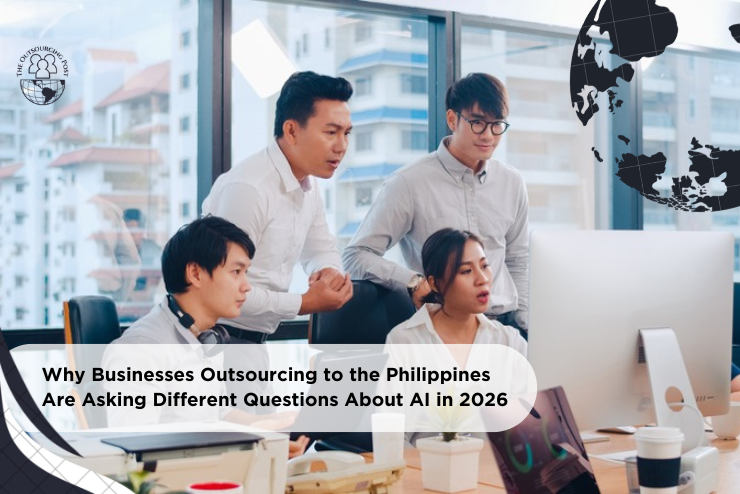
Businesses reviewing outsourcing to Philippines strategies are asking more detailed questions about AI, provider capability, and operational readiness in 2026.
For Australian and New Zealand companies, the offshore conversation has moved beyond simple cost comparison. Businesses still want access to skilled talent, improved capacity, and more efficient operating models. But AI has changed what due diligence now looks like.
The question is no longer only whether the Philippines is a strong outsourcing destination.
It is whether an offshore provider can support teams that are ready for AI-assisted work, secure systems, structured workflows, and higher expectations around quality.
This shift does not mean businesses expect offshore teams to be fully automated. It means they want confidence that offshore staff can use modern tools responsibly, protect sensitive information, and continue delivering consistent work as AI becomes more common in daily operations.
Offshore Due Diligence Is Becoming More Sophisticated
In the past, offshore provider conversations often focused on role availability, hiring timelines, labour cost, and basic operational setup.
Australian and New Zealand businesses are now asking more detailed questions about how offshore teams will actually operate once they are hired. They want to understand the provider’s systems, communication structure, training approach, data controls, and ability to support modern workflows.
This reflects a wider change in how offshore teams are being used.
Many offshore professionals now support:
Customer service
Administration
Finance support
Recruitment
Marketing
IT support
Data management
Reporting
Real estate operations
Workflow coordination
As these roles become more embedded in the business, the provider selection process becomes more important. Businesses want offshore teams that can work inside their systems, follow internal standards, and adapt as technology changes.

AI Capability Is Now Part of the Provider Conversation
AI is now part of the offshore due diligence process because it affects how teams work, communicate, and maintain quality.
Businesses are not necessarily asking providers to replace people with AI. In most cases, they are asking how AI can support offshore staff to work more efficiently.
AI may help with:
Drafting reports
Summarising documents
Organising information
Supporting content production
Preparing customer response templates
Reviewing repetitive data
Creating process documentation
Improving internal knowledge bases
These use cases can improve productivity, but only when there are clear rules around how AI is used.
For companies comparing the benefits of outsourcing in the Philippines, AI is becoming part of the broader value discussion. The focus is shifting from cost alone to how people, systems, and technology work together.
A strong offshore model in 2026 is not just about hiring capable staff. It is about creating a structure where those staff can use technology properly, with human review and clear accountability.
The Questions Buyers Are Asking in 2026
Australian and New Zealand businesses are becoming more specific when speaking with offshore providers.
They are asking questions such as:
Which AI tools can offshore staff use?
How are AI-assisted outputs reviewed?
What data should never be entered into AI platforms?
How are offshore staff trained on responsible AI use?
What happens if AI-generated work contains errors?
How does the provider support quality assurance?
Are there policies for data security and tool access?
Can AI be introduced without disrupting existing workflows?
These questions show that AI is being treated as an operational issue, not just a technology trend.
Businesses want to know whether the provider has enough structure to support AI safely. They also want to know whether offshore staff have the judgement to use AI as a support tool rather than a shortcut.

AI Raises the Standard for Offshore Team Management
AI can improve offshore team productivity, but it also raises expectations around management.
A team using AI tools needs clear instructions, review steps, escalation rules, and data handling guidelines. Without these, AI can create confusion, inconsistency, or unnecessary risk.
For example, an offshore marketing assistant might use AI to prepare a first draft of content. That can save time, but the work still needs review for accuracy, tone, brand alignment, and compliance.
An offshore admin assistant might use AI to summarise meeting notes or organise task lists. That can improve efficiency, but the final output still needs human checking.
An offshore customer service team might use AI-assisted response templates. That can help with speed, but staff still need to understand context, escalation rules, and customer expectations.
This is why AI readiness is not only about tools. It is also about training, workflow design, review processes, and provider support.
Data Security Has Become a Bigger Part of AI Due Diligence
AI has also made data security a more central part of offshore provider evaluation.
Australian and New Zealand businesses often share sensitive information with offshore teams. This may include customer records, internal documents, financial information, CRM data, reports, contracts, and operational details.
When AI tools are introduced, businesses need stronger clarity around what information can be used, who can access it, and how outputs are reviewed.
Companies involved in offshoring in the Philippines are increasingly looking at whether offshore teams have the right operating environment to support both productivity and control.
The risk is not AI itself. The risk is using AI without proper boundaries.
A responsible offshore setup should make it clear which tools are approved, what information is restricted, how staff are trained, and who checks AI-assisted work before it is finalised.

Offshore Talent Expectations Are Changing
AI is also changing how businesses think about offshore talent.
The most valuable offshore staff in 2026 are not only those who can complete assigned tasks. They are people who can follow structured processes, use digital tools responsibly, communicate clearly, and apply judgement when work requires human review.
This does not mean every offshore employee needs to be an AI specialist. It means offshore staff need to be adaptable.
They need to understand when AI can help, when it should not be used, and when something needs to be escalated to a manager or client-side decision-maker.
For businesses hiring offshore staff in the Philippines, this changes the recruitment conversation. Skills still matter, but so do communication habits, process discipline, digital confidence, and accountability.
AI makes these qualities more important because offshore teams are increasingly expected to work inside systems where technology supports output but people remain responsible for the result.
Why This Matters for AU/NZ Businesses
Australian and New Zealand companies often offshore to improve capacity, manage costs, and access skills that may be difficult to hire locally. AI adds another layer to that decision.
A business may not only want an offshore administrator, marketer, recruiter, IT support specialist, finance assistant, or customer service representative. It may want someone who can work with modern tools, follow defined workflows, and help improve output without increasing management pressure. This makes provider selection more important.
The strongest offshore providers will not simply supply candidates. They will help create the environment around those candidates so the offshore team can work securely, communicate clearly, and adapt to changing tools.
That environment may include:
Clear onboarding
Secure systems
Defined workflows
AI usage guidelines
Quality review steps
Staff training
Communication routines
Ongoing operational support
In 2026, AI readiness is becoming part of offshore readiness.

The Philippines Remains Strong, But Execution Matters More
The Philippines continues to hold strong appeal for Australian and New Zealand companies because of its skilled workforce, English communication, service experience, and familiarity with Western business practices. But choosing the country is only one part of the decision. The provider still matters.
A business can choose the right offshore destination and still struggle if the operating model is weak. If workflows are unclear, data rules are loose, communication is inconsistent, or staff are not trained properly, AI may create more risk than value.
But when the provider, systems, people, and processes are aligned, AI can help offshore teams work with more consistency and efficiency.
That is why offshore due diligence is changing.
Businesses are no longer only asking whether the Philippines is a good outsourcing destination. They are asking whether their provider can help them build a team ready for the next stage of work.
The Bottom Line
In 2026, AI is becoming part of the offshore provider conversation for Australian and New Zealand businesses.
Cost and talent still matter, but buyers are asking deeper questions about technology, data security, quality assurance, staff training, and workflow readiness.
This does not mean AI will replace offshore teams. It means offshore teams need better systems, clearer processes, and stronger provider support as work becomes more technology-assisted.
For businesses outsourcing to the Philippines, the most important question is no longer only where to offshore. It is who can help build an offshore team that is ready for what comes next.
If your business is exploring offshore staffing in the Philippines, Shore360 can help you build a dedicated team with recruitment, technology, HR, facilities, engagement, and operational support designed for long-term growth.

Comments